Commerce / Field note
Review product variants before small inconsistencies spread
A practical agent workflow for checking option names, identifiers and image relationships without inventing missing variants.
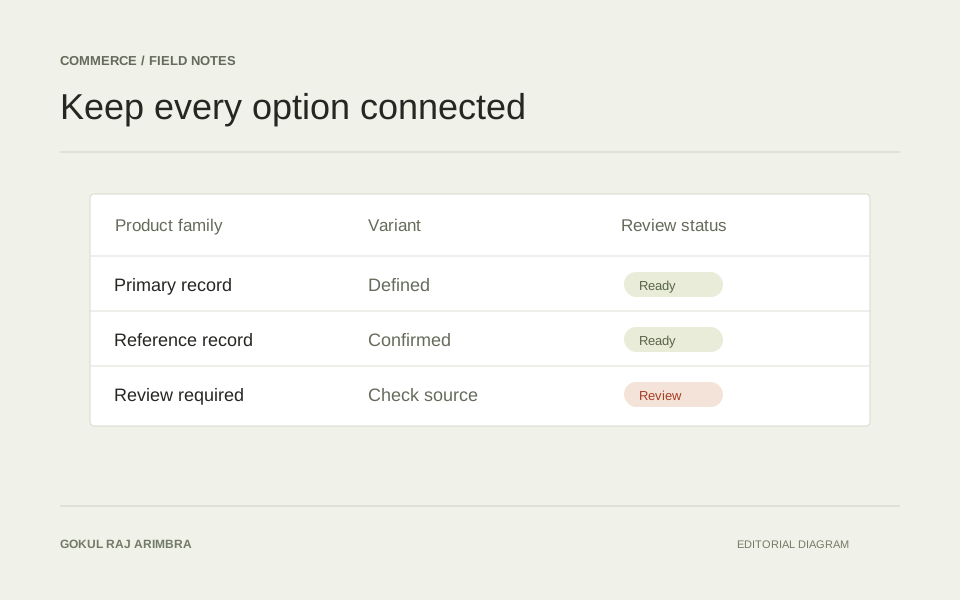
Product variants connect several parts of a storefront at once: the options a customer chooses, the image they see, the price they expect and the record the business fulfils. A small inconsistency can therefore appear in several places throughout the journey.
A variant-review agent can help organise those inconsistencies into a manageable queue. Its first job is to compare related records and explain possible problems. It should not create missing combinations or merge products simply because a pattern looks incomplete.
Make the product structure explicit
Start with a stable product identifier and the variants that belong to it. Include the option names and values, variant identifiers, relevant commercial fields and image references. Preserve the source values even when you create a normalised version for comparison.
Shopify describes a variant as a particular combination of a product's option values, such as a size and colour. That distinction matters: the product is the parent context, while each available combination has its own identity. Shopify's explanation of variants.
For an illustrative clothing product, several records might use “Medium” while another uses “M”. That could be a naming inconsistency worth reviewing. It does not prove that the underlying inventory records are interchangeable or that one should be deleted.
Check rules before asking for interpretation
Use straightforward checks for duplicate identifiers, empty option values and repeated combinations. These conditions can often be identified without asking a model to interpret the catalogue.
Use an AI review for the less mechanical questions: whether two descriptions appear to refer to the same option, whether a title contradicts the selected variant, or whether an image caption introduces a different product configuration.
Keep those findings separate. A confirmed duplicate identifier and a possible naming mismatch need different handling, even if both appear on the same product.
Do not assume every combination should exist
A product with several sizes and colours does not necessarily sell every possible pairing. Some combinations may never have existed, may have been retired or may be intentionally excluded from the range.
Ask the workflow to compare the available variants with an approved range definition when one exists. Without that reference, an absent combination is a question for the catalogue owner. It is not permission to invent a new variant or stock quantity.
Likewise, an image that appears to show another colour should produce a review item with the complete image and the recorded option. A model's visual interpretation should not silently overwrite a verified product field.
Make the proposed change easy to check
For each issue, show the product, affected variants, original values, suggested normalisation and supporting evidence. A reviewer should understand whether accepting the proposal changes presentation, a stored identifier or the available product range.
Start with a small set of products that includes straightforward records and deliberate exceptions. Ask the catalogue owner to review both the flagged issues and a sample of the records marked clear.
Keep a history of decisions so an intentional exception is not repeatedly reported as a new problem. A useful review system gradually makes the catalogue more consistent while preserving the distinctions that the business and its customers actually depend on.