AI & Tools / Field note
Use ChatGPT to make e-commerce research easier to check
A practical way to organise product, competitor and customer research around clear questions, traceable sources and useful next steps.
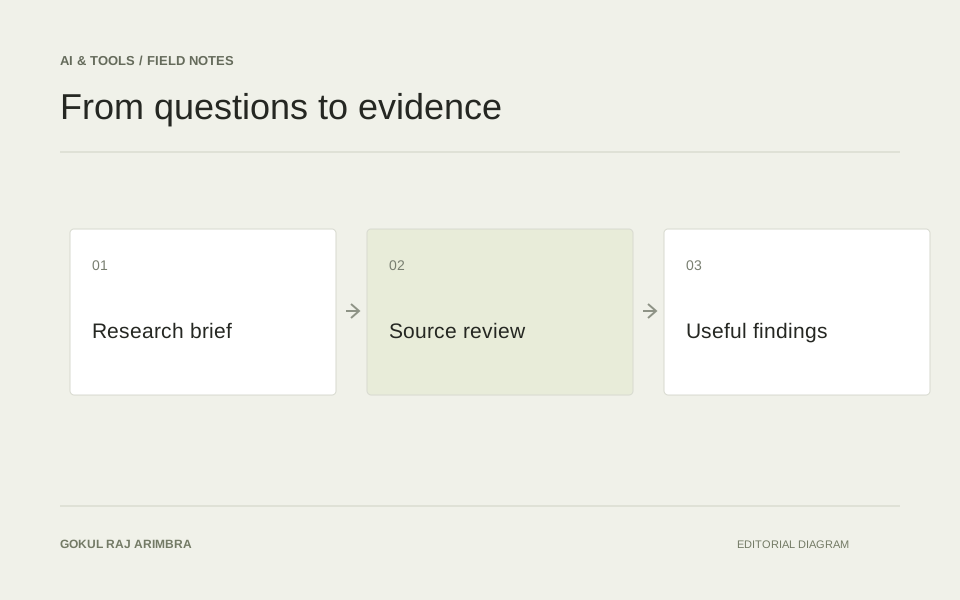
An e-commerce research brief should help someone make a decision. A long collection of observations about competitors can look substantial while leaving the important question unanswered: what should we investigate or change in our own store?
ChatGPT can be part of a useful research workflow when the question, source material and expected output are clear. The practical challenge is preserving the connection between a finding and the evidence behind it, especially when the result is passed to someone who did not collect the sources.
Begin with one decision
Choose a question with a defined audience and context. “How do these retailers explain refurbished condition before checkout?” is more useful than “Research the market”. It gives the review boundaries and makes it possible to tell whether the answer is complete.
Write down what is outside the task as well. You might review product-page explanations without trying to estimate competitors' sales, internal conversion rates or campaign profitability. Public pages do not provide those private facts, and a research summary should not manufacture them.
Build a source list before the synthesis
Collect the pages, documents or approved notes you want reviewed. Record a URL or file reference, the date checked and which part is relevant. If a page cannot be accessed, mark it as unavailable instead of allowing its apparent title to stand in for its contents.
OpenAI's research guidance recommends identifying the evidence collection, distinguishing authoritative material from background information and resolving missing or duplicate sources before synthesis. That approach transfers well to a focused commerce research brief. ChatGPT research evidence guidance.
For a condition-information review, the source list might include several product pages, the retailers' condition guides and your own customer-facing policy. Keep each document's role clear. A competitor's description is evidence of what that competitor says, not proof that your business can make the same promise.
Request a comparison with traceability
Ask for a table containing the retailer or source, the exact information available, where it appears in the journey and an unresolved question. Add a separate section for possible improvements to your own experience.
For example, the research might find that one store links condition details beside the product title while another places them in a lower accordion. The proposed action could be to test whether your own condition explanation is visible enough. The observation and the recommendation belong in different columns.
Where research tools or search are available, still open the cited source before accepting a claim. Check that the source actually supports the statement, and note when the information was observed. Pages, prices and policies can change.
Turn findings into a small investigation
Choose a few observations that matter to your customers. Convert each into a question your team can answer through a page review, support-ticket analysis or a focused usability session. A research brief is stronger when it ends with specific work and an owner.
Before sharing it, check the citations, remove unsupported conclusions and keep uncertainty visible. The finished document should let a colleague follow the path from the original question to the source, the finding and the proposed next step without having to repeat the entire research exercise.